Toyota Q1 Profit Falls 8.8%, but Earnings Base Remains Solid


Toyota Motor reported operating profit of ¥1.0634 trillion for the April–June 2026 quarter, down 8.8% year on year, amid pressure from the deteriorating situation in the Middle East, a slowdown in China, and U.S. tariffs. However, strong hybrid electric vehicle (HEV) sales continued to support earnings, while Toyota moves to expand production capacity and develop next-generation HEV batteries to strengthen competitiveness.
Hybrid Sales Support Earnings Amid Multiple Headwinds
Japan, August 4, 2026 — Toyota Motor reported consolidated results for the April–June 2026 quarter, with operating profit at ¥1.0634 trillion, down 8.8% from the same period a year earlier. Net sales reached ¥13.5254 trillion, surpassing the previous year and setting a new record high.
The results came despite multiple external pressures, including the situation in the Middle East, a slowdown in the Chinese market, and the impact of U.S. tariffs.
Nevertheless, Toyota generated more than ¥1 trillion in operating profit in a single quarter, supported in part by strong hybrid vehicle sales.
⟶ Read more: Toyota Targets JPY 50 Trillion Sales
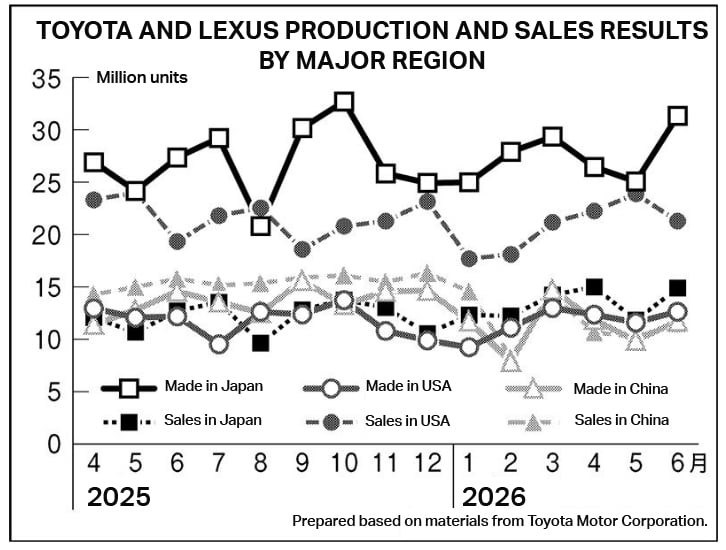
Toyota said HEV sales are trending upward across several regions, including Japan, North America, and China. The company plans to expand production capacity while improving hybrid vehicle performance to support the next phase of growth.
Production Lines to Shift to Next-Generation HEV Batteries
One of Toyota's key initiatives is strengthening batteries for hybrid vehicles, with a focus on both performance and cost competitiveness.
The company plans to convert battery production lines with capacity equivalent to approximately 600,000 hybrid vehicles to next-generation battery production between 2027 and 2028.
According to Toyota, the transition is intended to improve battery performance while enhancing cost competitiveness.
The Nikkan Kogyo Shimbun report further states that Toyota plans to shift the relevant production from existing nickel-metal hydride (NiMH) batteries to lithium-ion batteries (LiB).
Strengthening Regional Battery Supply
Toyota is also working to strengthen its battery supply structure through cooperation with partners. According to the Nikkan Kogyo Shimbun report, CATL will supply batteries for approximately 200,000 hybrid vehicles for Toyota in Indonesia, while production lines at Toyota Battery will be converted to next-generation battery production.
Strengthening battery capabilities is expected to support the competitiveness of Toyota's hybrid vehicles while the company maintains strong HEV sales across multiple markets.
Toyota's latest official results confirm the plan to convert capacity equivalent to approximately 600,000 vehicles to next-generation HEV batteries in Japan during 2027–2028.
⟶ Read more: Automakers’ Electrification Strategies Diverge
Mitigating the Impact of the Middle East and U.S. Tariffs
Toyota is also working to mitigate the impact of external risks, particularly the situation in the Middle East and U.S. tariffs.
The company reduced its estimated annual operating-profit impact from the Middle East situation from ¥670 billion to approximately ¥510 billion, supported by measures including changes to logistics routes.
Regarding U.S. tariffs, Toyota is working with suppliers to reduce the expected impact, lowering its estimated annual negative effect from ¥1.38 trillion to ¥1.31 trillion.
China Slowdown Drives Greater Localization
China remains a challenge as overall market growth has slowed, limiting the effectiveness of short-term measures.
Toyota is therefore placing greater emphasis on localization and plans to work with partners to develop vehicles specifically for the Chinese market.
The approach reflects Toyota's efforts to strengthen its business structure and build a revenue base capable of withstanding changing market conditions across regions.
Building a Stronger Earnings Base for Long-Term Growth
Despite geopolitical risks, the slowdown in China, and U.S. trade policies, Toyota continues to see opportunities from strong demand for hybrid vehicles.
Expanding HEV production capacity alongside the development of next-generation batteries has therefore become a key part of Toyota's strategy to improve both performance and cost competitiveness.
Toyota also raised its consolidated earnings outlook for the fiscal year ending March 2027, targeting stronger sales and profits as it works to build a more resilient earnings base.
Source: Nikkan Kogyo Shimbun